
Pathway to Distinction Collegiate Diploma
The Whitby Collegiate Diploma For Year 11 Students
-
The Collegiate Diploma is designed to be a school-based qualification guided by principles that prioritise both academic rigour and holistic student development.
Key Philosophy/Guiding Principles
Build Strong Foundations: Ensure students acquire deep conceptual understanding and essential skills in core subjects, providing a rigorous preparation for Year 12 (NCEA Level 2 or the proposed NZCE).
Prioritise Literacy and Numeracy: Explicitly develop and assess high levels of literacy and numeracy across the curriculum.
Foster Academic Rigour: Maintain high academic standards through challenging content, demanding assessments, and an emphasis on critical thinking and independent learning.
Promote Holistic Development: Encourage intellectual curiosity, creativity, resilience, and a growth mindset alongside academic achievement.
Prepare for Future Pathways: Equip students for success in senior NCEA levels, proposed new national qualifications (NZCE/NZACE), university, vocational training, or direct employment.
Capabilities and Cultural Practice
The Collegiate Diploma is designed to embed 21st Century Capabilities, including critical thinking, collaboration, creativity, digital literacy, and intercultural competence.
-
Differentiation and Support
The Collegiate Diploma includes various methods for supporting different learning needs, with specific subjects providing differentiated learning opportunities.
Students with specific learning differences will be supported with appropriate Special Assessment Conditions - these can include, Computer Use, Extra Time, Small Group Accommodation, Isolated Accommodation, and a Reader/Writer.
Optional Level 2 Extension Opportunities
Many subjects will offer optional Level 2 NCEA standards as extension opportunities for high-achieving students, ensuring readiness for senior courses. This will be on an invitation basis, although requests for extension will be considered.
-
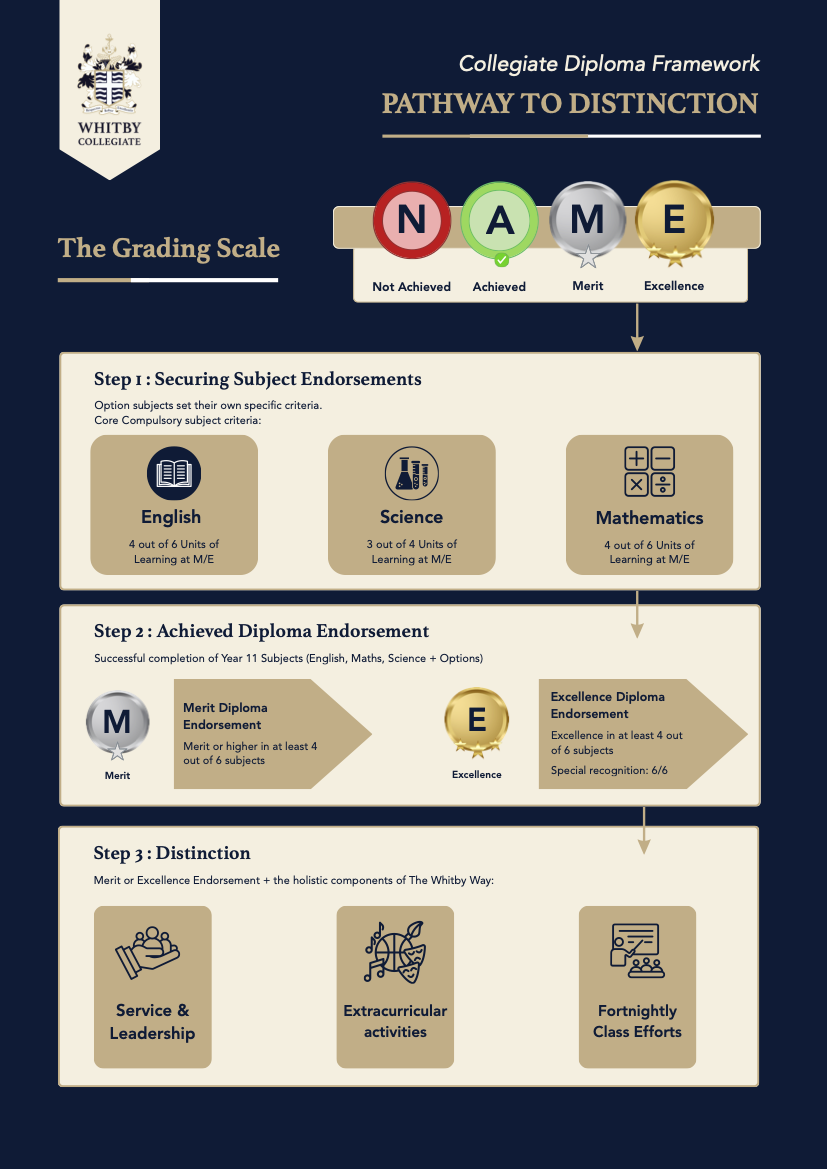
All assessments (except for the Unit Standards in Outdoor Recreation) will be assessed as Not Achieved (N), Achieved (A), Achieved with Merit (M), or Achieved with Excellence (E). The Collegiate Diploma will include both Subject and Overall Endorsements, based on both academic achievement and holistic engagement.
Overall Achievement of the Collegiate Diploma
Achievement of the majority of subjects (4/6).
Subject areas will define their own specific criteria as to the number of Units of Learning required to pass (i.e. English requires achievement of 4/6 Units of Learning to achieve the subject).
Subject Endorsement (Merit/Excellence)
Subject areas will define their own specific criteria.
Endorsement may require achieving Merit/Excellence in specific Units of Learning, the majority of units, or a combination of both.
Overall Year 11 Endorsement
To achieve a Collegiate Diploma Merit or Excellence Endorsement, students must meet certain requirements.
Academic Achievement: Gaining an endorsement in the majority of subjects (4/6). Extra recognition is being considered for students who earn Excellence endorsements in all subjects.
Holistic Components: Students may also have their Year 11 endorsement recognised with Distinction, based on:
Service / Leadership.
Extracurricular participation.
Class Effort and following The Whitby Way.
-
The Collegiate Diploma integrates core academic subjects with opportunities for specialisation and skill development.
Core Compulsory Subjects (Deep Dive & Foundational Skills)
These subjects focus on deep conceptual understanding and essential skills:
English Language & Literature: Focuses on advanced reading comprehension, analytical writing (essays, reports), oral communication, and critical engagement with diverse texts.
Mathematics: Comprehensive coverage of foundational mathematical concepts, problem-solving, logical reasoning, and data interpretation.
Science: Covers core concepts from Physics, Chemistry, and Biology. Focuses on scientific inquiry, experimental design, and data analysis.
Optional Subjects (Specialisation & Exploration)
Students choose 3 option subjects to allow for the exploration of interests and potential Year 12 pathways. Option subject areas include:
Design & Visual Technology
Digital Technology
Health & Physical Education
Humanities (Economics & Business, Accounting & Business, History, Geography)
Languages
Music
Visual Arts
Pathway to Senior Years
The Collegiate Diploma is explicitly designed to prepare students rigorously for their last two years of secondary schooling:
NCEA Alignment: The programme ensures students acquire the deep conceptual understanding and skills needed to succeed in NCEA Level 2 and Level 3 during the transition period.
Literacy and Numeracy co-requisites: The Collegiate Diploma integrates explicit development and assessment to ensure proficiency, addressing the co-requisite requirements for the senior NCEA levels.
Future National Qualifications: The certificate's emphasis on foundational literacy and numeracy aligns strongly with the New Zealand Government's proposed "Foundational Skills Award" and the future New Zealand Certificate of Education (NZCE).
-
Units of Learning will include:
Responding to Unfamiliar Text
Response to written text
Response to visual text
Exploring Language in Context
Crafting and publishing a piece of writing
Personal Response to an independently read text
Students will be assessed over the course of the year by four in-class assessments, and by two examinations (mid year and end of year).
Achievement of the subject is 4/6 Units of Learning.
Merit and Excellence subject endorsements in English will be awarded to students who pass four Units of Learning with Merit or Excellence grades.
The extension opportunity for students will be the completion of the NCEA Level 2 Internal Assessment AS91102 Construct and deliver a crafted and controlled oral text (3 credits).
Level 2 English in Year 12 is a compulsory subject.
-
Units of Learning will include:
Probability
Trigonometry
Statistics (Multivariate)
Algebra
Tables, Equations and Graphs
Bivariate
Students will be assessed over the course of the year by three in-class assessments, and by two examinations (mid year and end of year).
Achievement of the subject is 4/6 Units of Learning.
Merit and Excellence subject endorsements in Mathematics will be awarded to students who pass four Units of Learning with Merit or Excellence grades.
The extension opportunity for students will be the completion of the NCEA Level 2 Internal assessment AS91263 Design a questionnaire (3 credits).
Prerequisites for entry to Level 2 Mathematics subjects in Year 12 are as below:
Level 2 Mathematics with Calculus: recommendation is Merit endorsement for Mathematics, including Merit in Algebra
Level 2 Mathematics with Statistics: Achieving four of the six Units of Learning, including Statistics and Probability
-
Units of Learning will include:
Chemical Reactions
Genetics
Energy
Practical Investigation
Students will be assessed over the course of the year by two in-class assessments, and by two examinations (mid year and end of year).
Achievement of the subject is 3/4 Units of Learning.
Merit and Excellence subject endorsements in Science will be awarded to students who pass three of the four Units of Learning with Merit or Excellence grades.
The extension opportunity for students will be the completion of one of the following NCEA Level 2 Internal Assessments:
AS91155 Analyse the biological validity of information presented to the public (3 credits)
AS91172 Atomic and Nuclear Physics (3 credits)
AS91163 Demonstrate understanding of the chemistry used in the development of a current technology (3 credits)
In addition to achieving 3 of the 4 Science Units of Learning, prerequisites for entry to specific Level 2 Science subjects in Year 12 are as below:
Level 2 Biology: recommendation is Genetics assessment Achieved with Merit
Level 2 Physics: recommendation is Energy assessment Achieved with Merit
Level 2 Chemistry: recommendation is Chemical Reactions assessment Achieved with Merit
-
Design & Visual Communication
Units of Learning will include:
Freehand Sketching
Drawing out ideas
Architectural research and analysis
Architectural & Spatial Terminology (design & construction)
Technical Drawing (CAD spatial & product design)
Students will be assessed over the course of the year by two in-class assessments to define skills and knowledge, and one critical in-class assessment to assess research and drawing out of ideas at the end of year.
Achievement of the subject is 3/4 Units of Learning.
Merit and Excellence subject endorsements in DVC will be awarded to students who pass three Units of Learning with Merit or Excellence grades.
The extension opportunity for students will be the completion of the NCEA Level 2 Internal Assessment AS91340 Design and Visual Communication (DVC) Use the characteristics of a design movement or era to inform own design ideas (3 Credits)
Prerequisites for entry to Level 2 DVC in Year 12 include Achieving three of the four Units of Learning, including the examination.
Digital Design
Units of Learning will include:
Motion Design Foundations
Design Systems & Visual Identity
Advanced Digital Outcome
Research Inquiry Preparation
Students will be assessed over the course of the year by three in-class assessments, and by one research & reflection task.
Achievement of the subject is 3/4 Units of Learning.
The extension opportunity for students will be the completion of NCEA Level 2 AS91893 Use advanced techniques to develop a digital media outcome (4 credits).
-
Digital Technology
Units of Learning will include:
3D Modelling and Animation
Programming Basics with Python
Game Design and Development with Godot
Design and Develop Your Own Digital Outcome
Students will be assessed over the course of the year by two in-class assessments, and by two examinations (mid-year and end of year).
Achievement of the subject is 3/4 Units of Learning.
The extension opportunity for students will be the completion of the NCEA Level 2 Internal Assessment AS91896 Use advanced programming techniques to develop a computer program (6 credits).
-
Health
Units of Learning will include:
Holistic Hauora
Decision Making
Influencing factors that affect hauora
Strategies to enhance hauora
Students will be assessed over the course of the year by two in-class assessments, and by one end of year examination.
Achievement of the subject is 3/4 Units of Learning.
Merit and Excellence subject endorsements in Health will be awarded to students who pass two Units of Learning with Merit or Excellence grades.
There is no capacity for a Level 2 assessment to be completed in Year 11 Health. Teaching and learning activities will align with Level 2 content.
There are no prerequisites for entry to Level 2 Health in Year 12.
Outdoor Education
Students taking this course will be completing Level 2 Unit Standards.
Activities contributing to assessment may include:
Rock Climbing
Abseiling
Caving
Tramping
Paddling
Orienteering
River Crossing
This course does not include examinations but may include in-class assessments in addition to the skills-based assessments outlined above.
The Outdoor Education course does not award Merit or Excellence endorsement. Participation in this subject will be taken into consideration when considering overall Year 11 Programme Endorsement.
Physical Education
Units of Learning will include:
Perform a physical activity in an applied setting.
Demonstrate understanding of the role and significance of physical activity for young people and its effects on Hauora.
Explore how the body moves, functions, and performs in sport and physical activity.
Apply leadership strategies while coaching a group, evaluate their effectiveness.
Consistently demonstrate social responsibility through applying a social responsibility model in physical activity (Level 2)
Students will be assessed over the course of the year by two internal in class assessments, and by two examinations (mid year and end of year).
Achievement of the subject is 3/4 Units of Learning.
Merit and Excellence subject endorsements in Physical Education will be awarded to students who pass three Units of Learning with Merit or Excellence grades.
All students will complete the NCEA Level 2 Internal Assessment AS91334 Consistently demonstrate social responsibility through applying a social responsibility model in physical activity (3 credits).
There are no prerequisites for entry to Level 2 Physical Education in Year 12, but it is recommended that students who want to take Level 2 PE take Year 11 PE.
-
Accounting and Business
Units of Learning will include:
Understanding of accounting concepts that underpin financial decision making
Processing of general journal, ledgers and balance day adjustments
Preparation of financial statements for a small to medium sized business
Analysis and interpretation of financial progress of a small to medium sized business
Students will be assessed over the course of the year by four examinations (mid year and end of year), as well as an optional Level 2 extension opportunity (report).
Achievement of the subject is 4/6 Units of Learning.
Merit and Excellence subject endorsements in Year 11 Accounting and Business will be awarded to students who pass four Units of Learning with Merit or Excellence grades.
The extension opportunity for students will be the completion of the NCEA Level 2 Internal Assessment AS90847 Investigate the application of motivation theory in a business (3 credits).
Prerequisites for entry to Level 2 Accounting and Business in Year 12 include: An Achieved grade in three out of four Accounting Units of Learning listed above.
Economics and Business
Units of Learning will include:
Microeconomics - models (supply, demand, the market, and an introduction to government interventions such as indirect taxes)
Microeconomics - international trade (export and import markets)
Macroeconomics - models (circular flow model, and aggregate demand and aggregate supply models)
Macroeconomics - economic growth (measures of GDP and standard of living)
Students will be assessed over the course of the year by one in-class assessment, three examinations (mid year and end of year), as well as an optional Level 2 extension opportunity (report).
Achievement of the subject is 4/6 Units of Learning.
Merit and Excellence subject endorsements in Year 11 Economics and Business will be awarded to students who pass four Units of Learning with Merit or Excellence grades.
The extension opportunity for students will be the completion of the NCEA Level 2 Internal Assessment AS90847 Investigate the application of motivation theory in a business (3 credits).
Prerequisites for entry to Level 2 Economics and Business in Year 12 include: An Achieved grade in three out of four Economics Units of Learning listed.
Geography
Units of Learning will include:
Natural processes
Geographical perspectives
Geography skills
Global population distribution
Students will be assessed over the course of the year by three in-class assessments, and by one end of year examination.
Achievement of the subject is 3/4 Units of Learning.
Merit and Excellence subject endorsements in Geography will be awarded to students who pass three Units of Learning with Merit or Excellence grades.
There is no capacity to offer Level 2 standards in this course, but an opportunity will be given for students to have their Global Population Distribution paper marked under the Level 2 criteria for feedforward for Year 12.
Prerequisites for entry to Level 2 Geography in Year 12 include: An Achieved grade in three out of four Units of Learning listed.
History
Units of Learning will include:
Beyond the Goalposts: How Rugby Shapes New Zealand Society
World War Two and the Impact of the Atomic Bomb
Famous WW2 Battles significant to NZ
Protests in New Zealand
Students will be assessed over the course of the year by three in-class assessments, and by two examinations (mid year and end of year).
Achievement of the subject is 3/4 Units of Learning.
Merit and Excellence subject endorsements in History will be awarded to students who pass three units of Learning with Merit or Excellence grades (one being an exam).
The extension opportunity for students will be the completion of the NCEA Level 2 Internal Assessment AS91232 Interpret different perspectives of people in an historical event that is of significance to New Zealanders (5 credits).
Prerequisites for entry to Level 2 History in Year 12 include:
Achieving three out of five assessments (one being an exam)
Similar results as shown in English or any other literacy-based subject.
-
Spanish
Units of Learning will include:
Family, friends and Self.
Holiday and free-time
Body and mind
School Life
Future Plans
The Place I Live In
Students will be assessed over the course of the year by weekly vocabulary tests and grammar tests, in-class assessments, and by an Interaction examination and a Listening and Reading examination (end of year).
Achievement of the subject is 4/6 Units of Learning.
Merit and Excellence subject endorsements in Spanish will be awarded to students who pass the Interaction, and Listening or Reading assessment with Merit or Excellence grades.
There is no capacity for a Level 2 assessment to be completed in Year 11 Spanish. Teaching and learning activities will align with Level 2 content.
Prerequisites for entry to Level 2 Spanish in Year 12 include Achieving the Interaction examination, and at least Listening or Reading examinations.
-
Music
Units of Learning will include:
Aural skills
Theoretical knowledge
Music Analysis
Performance
Composition
Students will be assessed over the course of the year by three in-class assessments, and by one examination (Theoretical Knowledge and Aural skills) at the end of year.
Achievement of the subject is 3/4 Units of Learning.
Merit and Excellence subject endorsements in Music will be awarded to students who pass three Units of Learning with Merit or Excellence grades.
The extension opportunity for students will be the completion of the NCEA Level 2 Internal Assessment AS91273 Devise an instrumentation for an ensemble (4 credits).
Prerequisites for entry to Level 2 Music in Year 12 include Achieving three of the five Units of Learning, including the examination.
-
Visual Art
Units of Learning will include:
Drawing / Printmaking : Developing a Personal theme
Painting : Exploring Local theme ideas
Digital ( Photography and Design) : Investigation of wider Global theme
Exhibition planning / collaboration
Students will be assessed over the course of the year by 3 unit workbook submissions and subsequent resolved outcomes with a final Exhibition. No examinations.
Achievement of the subject is 3/4 Units of Learning.
Merit and Excellence subject endorsements in Visual Art will be awarded to students who pass three Units of Learning with Merit or Excellence grades.
The extension opportunity for invited students will be the completion of the NCEA Level 2 Internal Assessment AS91316 Develop ideas in a related series of drawings appropriate to established painting practice (4 credits).
There will also be opportunities for students to enter into National Art competitions, for example Emerging Artist Awards at the NZ Art Show.
Prerequisite for entry to any of the Level 2 Visual Arts courses (Design, Painting, Photography) in Year 12 is an Achieved grade in two out of three Units of Learning.